When Nobody Was Watching: The Recording Experiment That Brought Me Back to Life
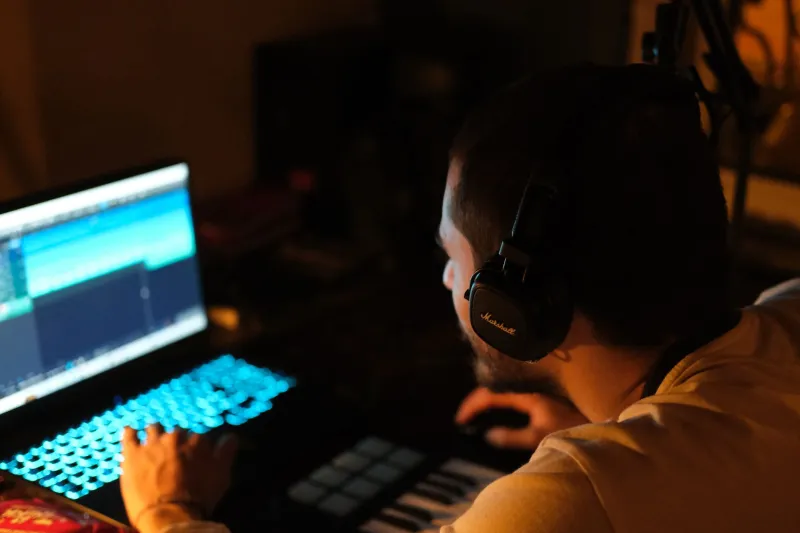
Somewhere between refreshing streaming dashboards and second-guessing every chord progression, I lost the thread. Not in a dramatic, blow-everything-up kind of way. More like a slow leak — the kind you don't notice until the tire's already flat and you're standing on the side of the road wondering how you got there.
I'd been making music long enough to know the difference between a good session and a productive one. Trouble was, those two things had stopped being the same thing. Productive meant deliverable. Good meant something harder to measure. And for a while, I let productive win every single time.
Then one Tuesday in February — no particular reason, no grand epiphany — I walked into my home studio, turned off my phone, and started recording something I never planned to release.
The Night I Stopped Asking Permission
I didn't tell anyone I was doing it. No social post. No note in my calendar. I just hit record and played.
What came out was messy. Tempo drifted. The vocal take had a creak in my voice I'd normally comp out in editing. There was a moment around the three-minute mark where I genuinely forgot what key I was in and just kind of wandered back in. And I left all of it. Because for the first time in longer than I care to admit, I wasn't auditioning. I was just making something.
That first session lasted about four hours. I walked away with three rough tracks that nobody asked for, nobody was waiting on, and nobody would ever use to evaluate whether I was worth their time. It felt almost illegal. Like I was getting away with something.
What Happens When You Remove the Finish Line
Here's the thing about creating without a commercial target: your brain stops doing that constant background calculation. You know the one — Is this too niche? Too weird? Will this work on a playlist? Does the hook hit in the first fifteen seconds? All of that noise just... quiets down.
And in the quiet, I started hearing things I'd been drowning out.
I heard that I actually love minor key melodies more than I'd been letting myself use them, because somewhere along the way I'd decided they were too sad for what people wanted from me. I heard that I'd been avoiding certain lyrical territory — the uncomfortable, specific, personal stuff — because I was scared of how it would read in a press release. I heard that I'd been writing around the truth instead of straight at it.
Those no-stakes sessions became a kind of archaeological dig into my own taste. Every track I made just for the sake of making it revealed something I'd buried under layers of strategy.
The Collaboration I Never Would Have Had
About six weeks into this private little experiment, I played one of those rough recordings for a friend — not a music industry contact, just a guy I'd known since high school who plays guitar for fun and has genuinely zero opinions about what's commercially viable. He heard something in it. Asked if he could add a part.
What followed was one of the most natural, unforced creative conversations I've had in years. We weren't trying to build something marketable. We were just two people following a sound to see where it went. He brought in a guitar texture I never would have thought to ask for, and it completely reframed the emotional center of the track.
That collaboration never would have happened if the song had been "official." Official songs come with stakes. Stakes make people careful. Careful makes people hold back. And when people hold back, you get polished instead of real.
I've since had a handful of similar moments — a vocalist friend who heard a rough mix and wanted to add a harmony, a producer I respect who caught wind of what I was doing and asked if he could sit in on a session just out of curiosity. Every single one of those connections happened because the work had no pressure attached to it. It was just an open door.
Relearning What the Craft Actually Is
I think a lot of artists — especially independent ones navigating the streaming era — quietly start to believe that music is a product first and an expression second. The metrics make it feel that way. The algorithm makes it feel that way. Even the language we use makes it feel that way: content, releases, rollout strategy.
But music was never supposed to be a rollout strategy. It was supposed to be the thing you made because something inside you needed to get out.
Those sessions nobody asked for reminded me of that. Not in a precious, romanticized way — I'm not about to pretend that commercial realities don't exist or that making a living as an artist doesn't require thinking about audience. It does. But there's a version of that thinking that becomes a cage if you're not careful. And I'd been living in that cage for a while without fully realizing it.
The recordings I made during that stretch — the ones born from pure stubbornness and zero expectation — ended up being some of the most honest work I've ever done. A few of them eventually found their way into actual releases, stripped down and refined but still carrying that original energy. That loose, wandering quality I'd always edited out? Turns out people connect with it. Turns out it sounds like a human being instead of a product.
The Permission You Have to Give Yourself
If there's anything I'd pass along from all of this, it's pretty simple: make something nobody asked for. Make it badly if you need to. Make it in the wrong key, in a genre you've never touched, at two in the morning when your voice is shot. Make it with no plan for what happens to it after.
Because sometimes the work that has no destination is the work that finally takes you somewhere.
The studio sessions nobody asked for saved my career — not because they produced hits, but because they produced me again. The version of me that got into this thing in the first place, before the dashboards and the strategies and the endless, exhausting question of whether any of it was working.
Turns out that version of me still had a lot left to say. He just needed a room with no audience to finally say it.