Two Voices, One Song: How Letting Other People In Changed Everything I Thought I Knew About My Music
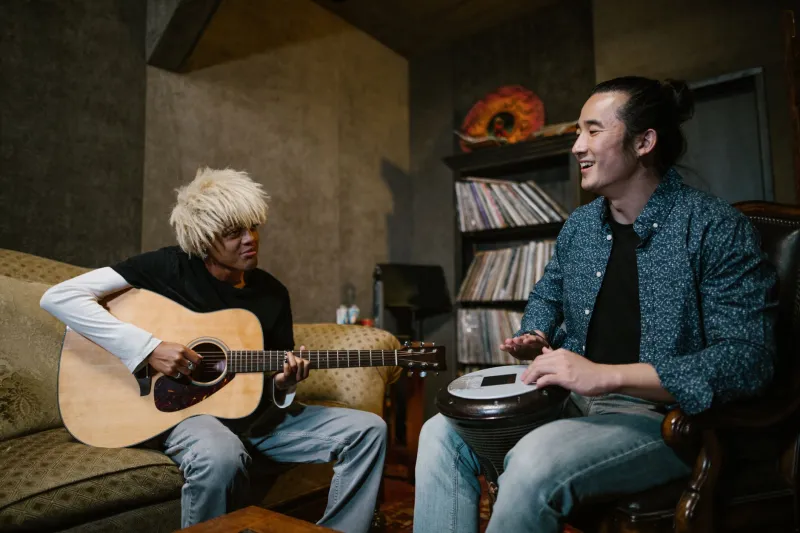
For a long time, I had this stubborn idea lodged in my brain. If someone else touched the work, it wasn't really mine anymore. If another voice showed up on a track, or another set of hands shaped a melody, then the whole thing became something diluted — less authentic, less me. I held onto that belief the way some people hold onto a lucky guitar pick. Tight, superstitious, a little irrational.
Then I started actually collaborating, and the whole thing fell apart. In the best possible way.
The Wall I Built Around My Studio
Look, I get why solo artists go that route. There's something clean about it. You have a vision, you chase it, nobody second-guesses your chord choices at two in the morning. The creative space is yours entirely. No compromises, no ego negotiations, no wondering if the other person is steering things somewhere you don't want to go.
But here's what I didn't see at the time: I was also building a ceiling. Every instinct I had went unchallenged. Every habit I'd developed — good or bad — got reinforced. I was getting really efficient at making music that sounded exactly like me, which sounds great until you realize "exactly like me" was starting to mean "exactly like the version of me from three years ago."
I wasn't growing. I was just getting more comfortable.
The First Crack in the Wall
The shift started almost by accident. A friend of mine — a songwriter from Nashville who writes in a completely different genre than I do — was crashing at my place for a weekend. We weren't planning to work. We were just hanging out, watching baseball, doing nothing in particular.
Somewhere around the third night, I picked up a guitar and started messing around with something I'd been stuck on for weeks. A melody I liked but couldn't figure out where to take. He listened for a minute, then said, "What if you just let that line breathe more? Like, stop filling every gap."
I almost argued with him. My instinct was to defend what I'd built. But I tried it his way, and I sat there in my own living room genuinely surprised by what I heard. The space he suggested changed the entire emotional weight of the thing. It sounded more vulnerable. More honest. More like something I'd actually want to listen to.
That one offhand comment cracked the wall.
What Shared Creative Space Actually Feels Like
I want to be real about something: collaboration is uncomfortable. At least it was for me at first. There's a specific kind of exposure that happens when another artist is watching you work through an idea in real time. You can't hide the messy middle. You can't only show people the finished, polished version of your process. They see the wrong turns, the moments of doubt, the takes that go nowhere.
And weirdly, that exposure is exactly where the good stuff lives.
When I started bringing other people into my creative process — not just as session players executing my instructions, but as genuine collaborators with their own perspectives and instincts — I noticed something that surprised me. My solo vision didn't disappear. It actually got sharper. Having to articulate what I was going for, defend the choices that mattered, and let go of the ones that didn't — that process clarified things I hadn't even consciously understood about my own music.
You don't really know what you believe until someone pushes back on it.
The Guest Feature That Rewrote My Rules
A few years back, I had the chance to work with a vocalist whose style is about as far from mine as you can get. Different background, different influences, different relationship to melody and rhythm. On paper, it probably shouldn't have worked. A lot of people in my circle quietly raised an eyebrow.
But the track we made together is still one of my favorites. Not because it sounds like me, exactly — it doesn't, not entirely. It sounds like a conversation between two people who see music differently but found a shared language for one song. There's a tension in it that I couldn't have manufactured alone. A push and pull that gives the whole thing life.
That experience rewired something in me. I stopped asking "does this sound like my stuff?" and started asking "does this sound true?" Those are different questions, and the second one leads somewhere more interesting.
Integrity Isn't the Same as Isolation
Here's the thing I had to unlearn: artistic integrity doesn't mean doing everything by yourself. It means staying honest about what you're trying to say, even when the path to saying it involves other people's voices and ideas.
Some of the most iconic music in American history came out of collaboration — Lennon and McCartney, Jagger and Richards, the Muscle Shoals sessions where a room full of musicians who'd never met each other made records that still give people chills. Those weren't compromises. Those were collisions that produced something none of those individuals could have reached alone.
I'm not comparing myself to any of that. But the principle holds at any scale.
What I Carry Forward
I still make solo records. I still have sessions where it's just me, the room, and whatever I'm trying to work through. That part of my process isn't going anywhere. But I hold it differently now. The door isn't locked from the inside anymore.
When the right person shows up with a perspective I haven't considered, I try to get curious instead of defensive. When a collaboration pulls me somewhere unexpected, I try to ask whether it's pulling me off my path or just showing me a part of the path I hadn't seen yet.
Most of the time, it's the second thing.
The paradox I started with — that working with others would compromise my solo vision — turned out to be exactly backwards. The collaborations didn't dilute what I was doing. They lit it up from a different angle. And what I saw when the light hit differently was a version of my own music I didn't know was possible.
That's worth a little discomfort. Every single time.